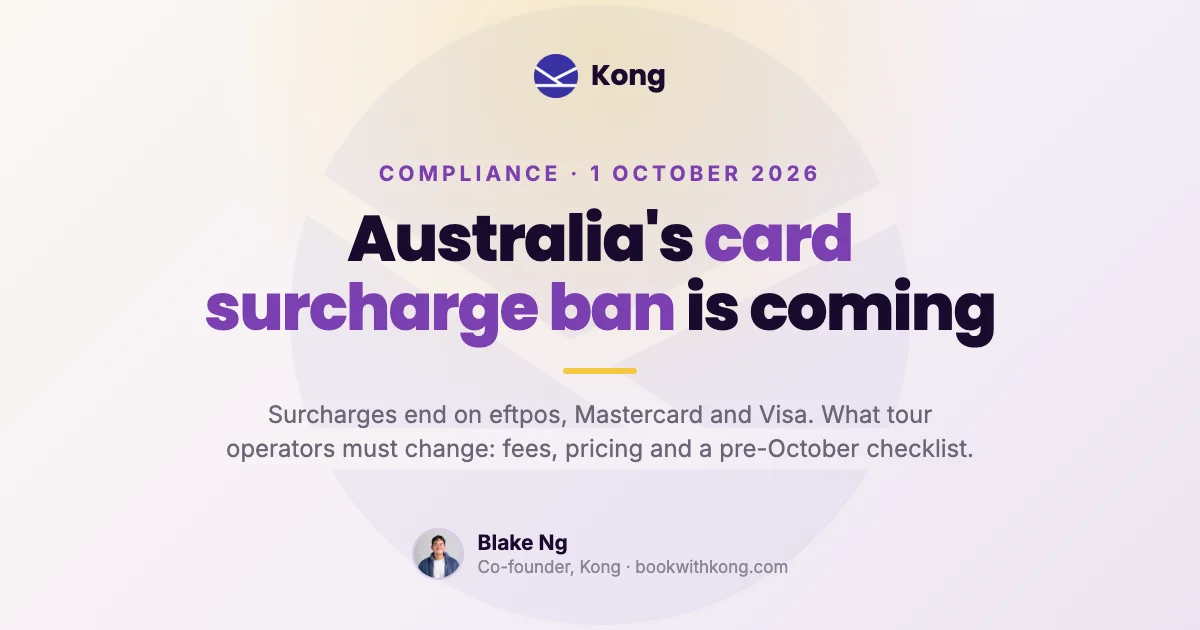
From 1 October 2026, businesses can no longer add a surcharge when a guest pays by card on the eftpos, Mastercard or Visa networks, across credit, debit and prepaid cards (RBA, verified 7 Aug 2026). American Express is removing surcharging from the same date voluntarily (RBA FAQs, verified 7 Aug 2026). If your checkout, terminal or phone-booking script adds a percentage for paying by card, that line has to go before October. Genuine booking fees and service fees that have nothing to do with how the guest pays are not affected, and the ACCC has warned that a card surcharge renamed "booking fee" is still a surcharge. This article covers what changes, what a genuine fee looks like for a tour business, your three options, and a pre-October checklist. It is general information, not legal or financial advice; for decisions about your own pricing, talk to your accountant or lawyer.
The whole article in four lines, for the operator between departures:
- Your three options: absorb the cost, fold it into your headline price, or restructure to a genuine payment-method-blind fee.
- Trap one: deposits taken now with balances paid after 1 October. The balance cannot be surcharged.
- Trap two: international or Amex-heavy card mixes. The surcharge goes in October; the cost relief comes later, or for Amex is not announced.
- The checklist at the end sequences the work.
Now the detail.
What actually changes on 1 October 2026
The mechanics matter for understanding what is and is not covered. The Reserve Bank of Australia is not directly fining surcharging businesses; it is removing its long-standing rule that stopped card networks from banning surcharges. All three designated networks, eftpos, Mastercard and Visa, have decided to impose "no-surcharge" rules from 1 October 2026, covering credit, debit and prepaid cards (RBA conclusions paper FAQs, verified 7 Aug 2026). The RBA's media release describes the package plainly: "removing surcharging on debit, prepaid and credit cards on the designated eftpos, Mastercard and Visa card networks" (rba.gov.au, verified 7 Aug 2026). Enforcement runs through your card network agreements and your payment processor, whose terms you accept to take cards at all.
The same package is built to cut what you pay to accept cards, though how much of the saving reaches you depends on your processor. From the same date, domestic debit and prepaid interchange fees are capped at 8 cents (or 0.16% ad valorem) and domestic consumer credit interchange at 0.3% of transaction value. Commercial credit stays capped at 0.8%. A 1.0% cap on foreign-issued cards follows later, on 1 April 2027 (RBA conclusions paper, verified 7 Aug 2026). Processors are already moving: Stripe's Australian pricing page notes lower pricing effective 1 October 2026 (stripe.com/au/pricing, verified 7 Aug 2026). The RBA estimates consumers currently pay about $1.6 billion a year in card surcharges (RBA conclusions paper, verified 7 Aug 2026); that is the pool being switched off.
One timing squeeze matters specifically for operators with international guests. From 1 October you cannot surcharge foreign-issued cards or Amex, but the interchange relief on foreign cards does not arrive until 1 April 2027, and Amex sits outside the RBA's interchange caps altogether. On a $120 booking paid with an overseas Visa through Stripe, international card processing runs at 3.5% plus 30 cents, about $4.50 (stripe.com/au/pricing, verified 7 Aug 2026); the $1.80 surcharge you were recovering against that cost disappears in October, and the cap on the cost itself is six months away. Before deciding whether to absorb or reprice, pull your last year of transactions by card type; an operator with 40% international guests is absorbing a different number than one with 5%.
As for what happens if you simply keep surcharging: the RBA's papers set out no merchant-level fine. The mechanism is contractual, running through the card networks' rules and your agreement with your payment processor, and the RBA says it will monitor compliance through data collections (RBA conclusions paper, verified 7 Aug 2026). Separately, the ACCC enforces the pricing display rules covered below. Betting that nobody checks is a bet about your processor's patience, not a legal strategy.
The edges of the ban, verified against the RBA's own FAQs (7 Aug 2026): weekend and public holiday surcharges are untouched. Discounts for paying a particular way, cash included, remain allowed. Buy now pay later is not covered by the RBA framework, though your BNPL provider's own contract almost certainly has its own rules; check it rather than assuming. There are no exemptions for small businesses or not-for-profits unless a network or law creates one. And timing runs on payment date, not invoice date: a card payment made on or after 1 October 2026 may not be surcharged even if you issued the invoice months earlier. Deposits taken now for spring departures with the balance due after 1 October fall exactly into that trap.
What counts as a genuine booking fee
Here is the line, in the RBA's words: "The changes only apply to surcharges added because a customer pays by card. They do not apply to weekend surcharges, public holiday surcharges, or booking fees or service fees" (RBA FAQs, verified 7 Aug 2026). The ACCC closes the renaming loophole: "A business can't escape the ban by calling a card payment surcharge something else. For example, if a business charges a service fee or handling fee that only applies to some payment methods, this is probably a card payment surcharge by another name" (accc.gov.au, verified 7 Aug 2026). The test is not what you call the fee. It is whether the fee exists because of how the guest pays.
Priced for a tour, non-compliant: you advertise a snorkel tour at $120. At checkout, guests paying by Visa see "+ 1.5% card fee, $1.80". Guests paying another way do not. That is a card surcharge, whatever the label, and from 1 October it breaches your network's rules.
Priced for a tour, compliant in structure: you charge a $3 booking fee on every booking, however the guest pays: Visa, eftpos, bank transfer, gift voucher, over the phone or in person. The fee is disclosed up front and, because it is mandatory, it belongs inside your advertised price under Australian Consumer Law: the ACCC requires the total price to be displayed as a single figure covering the minimum a customer could pay, and names "booking and service fees" dripped in during checkout as exactly the practice the law targets (accc.gov.au price displays, verified 7 Aug 2026). So the honest advertisement is $123, or $120 plus a clearly stated $3 booking fee on all bookings, not $120 with a surprise at the last screen.
One caveat stated plainly, because the regulators have not spelled this out for every scenario: the ACCC's "by another name" warning is written around the current excessive-surcharge rules, and how networks police edge cases after 1 October will emerge in practice. The safe reading is the conservative one: if a fee only exists when cards are involved, treat it as a surcharge and remove it.
Your three options before October
Absorb it. Delete the surcharge and take the cost into your margin. Softer landing than it sounds, but here is the honest arithmetic on a $120 booking. What you lose is known: a 1.5% surcharge was $1.80. What you get back is not yet a published number: the caps apply to interchange, one component of your merchant fee, and while Stripe has announced lower Australian pricing from 1 October, it has not yet published the new rate (stripe.com/au/pricing, verified 7 Aug 2026). So the absorb decision rests on a number only your processor can give you; ask for it in writing, and treat the relief timing by card type seriously:
| Card on a $120 booking | Surcharge you lose 1 Oct 2026 (illustrative 1.5%) | Current Stripe cost (verified 7 Aug 2026) | Cost relief arrives |
|---|---|---|---|
| Domestic debit or credit | $1.80 | $2.34 (1.7% + $0.30) | Caps from 1 Oct 2026; your rate is your processor's call |
| Foreign-issued card | $1.80 | $4.50 (3.5% + $0.30) | Cap from 1 Apr 2027, six months later |
| American Express | $1.80 | Ask your processor | No RBA cap; Amex is outside the interchange framework |
Whether a cleaner checkout also wins you bookings is a judgement call, not a promise of higher conversion.
Reprice. Fold the cost into the headline price: the $120 tour becomes $122. Transparent, legal, and how most of your costs already work; fuel and insurance are in the price, not itemised at checkout. If you sell through resellers as well as direct, remember rate parity: a price change on your site flows through your whole commission ladder, so reprice the product, not just one channel.
Restructure your fees. If you genuinely need a separate fee, for example a booking fee that funds free rescheduling or covers admin on every order, make it payment-method-blind, apply it to every booking, disclose it up front and fold it into the advertised total where it is unavoidable. A percentage fee can pass the same test as a flat one; what matters is that the trigger is the booking, never the payment method. One adjacent case to think through with your adviser: a fee charged on online bookings but not phone or walk-up bookings is channel-conditional rather than card-conditional, which raises pricing-display questions more than surcharge ones. Structure every fee around what it is for, not how the guest pays.
Whichever you choose, know what your booking software does at checkout on your behalf. If your platform adds a percentage to card payments under any label and you cannot switch it off or restructure it, that is a conversation to have with them now, not on 30 September. Fee structures vary widely across platforms and each platform can best explain its own; our Rezdy pricing breakdown walks through the published fees of one of the category's most established platforms, and the same checkout questions apply everywhere.
Kong does not get a pass on its own test. Kong's Australian pricing is a 1.8% booking fee paid by the guest, with the operator paying nothing. The fee's trigger is the booking, not the payment method. That answers the surcharge test. It is not the whole story. The single-price rules this article just walked through apply to that fee too: if you run the guest-paid plan, the fee is mandatory for your guests, so it belongs in the total your guest sees up front, not a surprise at the final screen. And the channel question above applies to us as well: ask how the fee treats a booking you key in by phone, the same question you should put to every platform. Check how it all displays on your own checkout before October, hold us to that standard, and ask us the hard questions.
The pre-October checklist
Work through this before your September departures are done:
- Audit every place a card fee can appear. Online checkout, terminal settings, phone-booking scripts, invoices and quotes. Anything conditional on card payment goes.
- Check bookings that straddle the date. Deposits taken before 1 October with balances collected after are payments made after the ban starts; surcharging those balances is the obvious first mistake.
- Reprice or restructure, then fix your advertised prices. Mandatory fees belong in the displayed total under the ACCC's single-price rules; while you are changing numbers, remove any drip pricing at the same time.
- Ask your processor about the new interchange caps. Lower caps take effect the same day. Ask what your rate does on 1 October, and shop it if the answer is "nothing".
- Confirm what your booking platform charges guests at checkout. Get it in writing if the answer is unclear, and ask specifically whether any guest-facing fee is conditional on payment method.
- Check your BNPL and gift voucher settings. BNPL sits outside the RBA framework but inside your provider contract; vouchers and bank transfers need consistent fee treatment if you keep any fee at all.
- Pull your card mix. Twelve months of transactions by card type: domestic, foreign-issued, Amex. The higher your foreign and Amex share, the bigger the gap between losing the surcharge in October and seeing cost relief, and the stronger the case for repricing rather than absorbing.
- Update your terms, your website FAQ and your staff. The guest-facing story should be one sentence: no card fees here, the price is the price.
FAQ
When does the card surcharge ban start in Australia?
1 October 2026. From that date, surcharges on eftpos, Mastercard and Visa cards, covering credit, debit and prepaid, end under the networks' no-surcharge rules, and American Express is removing surcharging voluntarily on the same date (RBA, verified 7 Aug 2026).
Can I still charge a booking fee after the surcharge ban?
Yes, if it is genuine: charged regardless of how the guest pays, disclosed up front, and included in your advertised price where it is mandatory. A fee that only applies to card payments is treated as a surcharge whatever you call it (RBA and ACCC, verified 7 Aug 2026).
Does the surcharge ban apply to buy now pay later?
No. BNPL is not covered by the RBA framework, which currently applies to the designated card networks. Your BNPL provider's own contract terms still govern what you can charge, so check them before adding any fee.
What happens if a booking was made before 1 October but paid after?
The payment date decides. The RBA states that a card payment made on or after 1 October 2026 may not be surcharged even if the invoice was issued earlier, which catches deposit-and-balance bookings that span the date (verified 7 Aug 2026).
Do card processing costs go down when the ban starts?
Caps on interchange fees drop the same day: 8 cents on domestic debit and prepaid, 0.3% on domestic consumer credit, with a 1.0% cap on foreign-issued cards from 1 April 2027. Whether your own rate falls depends on your processor, so ask directly (RBA, verified 7 Aug 2026).
Can I offer a discount for paying cash instead?
Yes. The RBA confirms businesses can continue to offer discounts for particular payment methods. A cash discount prices down; a card surcharge prices up, and only the surcharge is banned (verified 7 Aug 2026).
Are small businesses exempt from the surcharge ban?
No. The RBA's FAQs state businesses, including not-for-profits, are not exempt unless a card network's rules or a law creates an exemption. Assume it applies to you (verified 7 Aug 2026).